If your company acts like most financially-concerned businesses, you’ve already implemented at least some internal controls to uncover and prevent fraud within your expense system.
Maybe you’ve tied spend limits to your purchasing cards. Or, perhaps you are restricting use on specific merchant category codes (MCCs).
But while these steps are all important and useful, are your current controls enough? Upon closer examination, you might find more ways to improve your program’s fraud detection and take it to the next level.
A great way to take that next step is by recognizing and taking full advantage of the role data can play in fraud control. The data generated from your company’s transactions is rich with information that, once tapped into, can be extremely useful in preventing fraud.
Consider the following data-driven methods that can detect and deter fraud like never before!
Data mining to prep fraud detection
Data mining is the act of taking data from your expense transactions, examining it, and analyzing it to determine patterns of behavior.
Because it looks at real-use behavior trends on a grand scale, data mining allows you to discover and prevent fraud in a deeper way than simply setting use-restriction policies.
Because of its “all-encompassing” nature, the use of data mining is less limiting in the types of fraud it can discover. Whether the act consists of personal expenditure, invoice overpayment, or unauthorized use of payment cards and accounts, data mining digs out and identifies the precise cause of the fraud.
It also provides insights on where these fraudulent behaviors are actually originating and who is responsible — helping you get to the source of the matter.
Lastly, it has the ability to check and analyze massive amounts of information, and yet streamline the process. No human alone could go through and analyze the same amount of data — and do so as quickly and correctly — as the artificial intelligence (AI) behind data mining. Data mining processes a staggering amount of data, while being much more efficient and effective.
The AI angle
Artificial intelligence is a hot topic in the procurement and purchasing spaces, as evidenced by a 2026 survey from Deloitte. It is certainly a tool that can be used to fight fraud, and there are several different ways that it can accomplish this. For example, it can be used to:
- Identify anomalies and bring them to your attention
- Automate workflows to cut down on menial busywork
- Assist with policy compliance and bring “buried” information to attention quickly
- Utilize algorithmic machine learning to “learn” trends
Most methods of detecting fraud only do so after the fact. However, with machine learning, once the system “learns” the behavior trends, it then creates sets of data and rules that can often discern fraud in a more proactive way, that can actually lend itself to the prevention of fraud.
As we have discussed previously, artificial intelligence doesn’t need to, and frankly can’t, “replace” humans in purchasing and procurement. It is best thought of as a way to increase productivity and free up your time to make decisions and manage relationships.
Taking the next step towards fraud detection
As your company grows, so will your transactions. Having the means to track those increasing expenditures will become exponentially important. The ability to tap into all of that new and ever-growing data to discover and prevent fraud will be all-the-more valuable to your expense system, as well to your company’s overall financial health.
Card Integrity has the tools that can help you take your fraud control to the next level and make it even better than what it currently is. We understand and utilize data mining and machine learning in our solutions, so that your transaction data is always working for you, in the most efficient and effective way.
Misuse detection versus fraud detection
While it is important to detect fraud, it is also important to detect misuse and abuse, which are distinct from fraud. One of our most popular articles discusses the difference between fraud, misuse, and abuse. Basically, the differences are as follows:
- Fraud involves intentional deceit.
- Abuse involves noticing that you can “get away” with something, and making no effort to cover it up.
- Misuse involves legitimate mistakes or ignorance regarding policy.
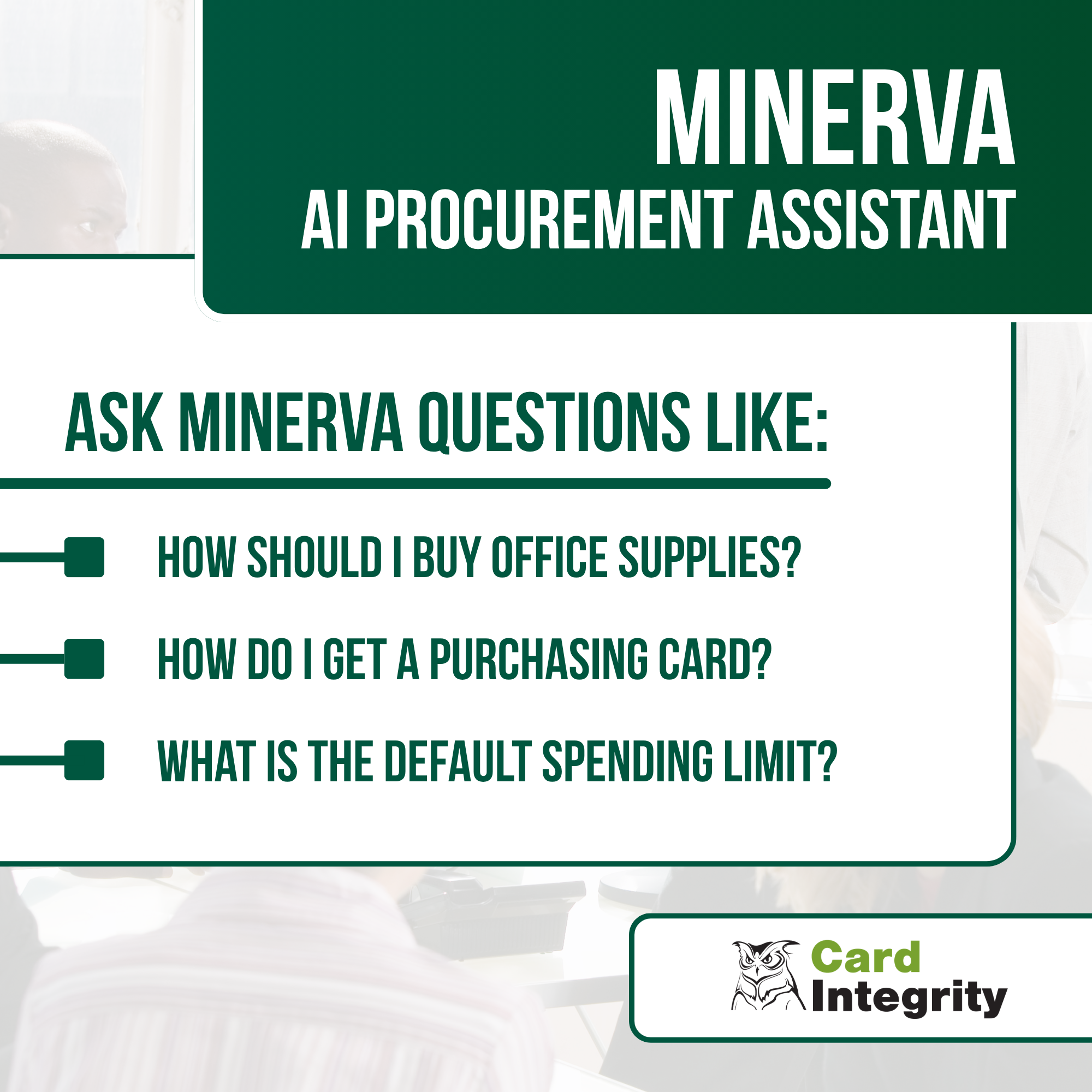
Misuse and abuse also lead to significant wasteful spending at organizations. AI can be used as a tool to detect all three. For example, Card Integrity’s AI agent, Minerva, specifically targets misuse by being a resource for cardholders to get instant answers about what they can and can’t do regarding their organization’s purchasing policy.
Meet Minerva: The AI Policy Assistant
If you are looking for innovative ways to incorporate AI into your procurement processes, consider the menial work your team covers on a daily basis that if freed up, could make you more productive.
We designed Minerva around the idea that procurement policies can often be cumbersome, both for cardholders/employees trying to get an answer to something, and for procurement professionals attempting to field their questions in a timely manner.
If you’re interested in learning more about Minerva, learn more by clicking below!
Article originally published on July 9, 2019. Updated May 12, 2026 in light of the shifting AI landscape.