Artificial intelligence (AI) solutions have been implemented into purchasing, finance, sourcing and procurement processes in a myriad of different ways. We see AI’s influence in the automatization and augmentation of various tasks with the goal of increasing efficiencies. As IBM puts it, “businesses that want to stay competitive … need to have deeper insights into their structured data sources. The advancements in computing power and AI technology can do just that and help organizations build out existing structured data”.
Therein lies a bit of a secondary point. Data structures are large, convoluted, and contain more data than an organization can realistically comb through by themselves. And unless that data is properly compiled, cleansed, and presented in a way that is easy to understand, its use to your organization is limited. That’s where data visibility comes in, especially as it relates to what we call “spend data” (such as corporate card or T&E card expenses).
Risks of poor spend data visibility
Spend data visibility allows organizations to understand precisely where money is being allocated. It also allows them to quickly access accurate spend data when necessary. It goes without saying why data visibility is important. Despite this, many organizations struggle with poor visibility, due in part to the following risks:
- Communication breakdowns. Organizational silos and poor communication across departments can lead to duplicate payments and other issues. If, for example, the person in charge of the purchasing card (“P-Card”) program and the accounts payable department do not have visibility into what one another are doing, it can lead to duplicate payments where the same vendor is paid twice.
- Mismanaged data and outdated systems. Issues with how vendors appear in your system, duplicate merchant codes, or inconsistent vendor names can compound data visibility problems.
- Multiple data sources. If you are gathering spend data from many different sources (cards, travel, invoices, ERP, bank, etc.) it adds to the complexity and leaves your data prone to categorization errors.
How AI can help
AI and automation can aid visibility and transparency of spend data. AI is particularly effective in increasing efficiency by performing menial tasks such as automating workflows and identifying anomalies. When you have such a significant amount of data, it becomes difficult or impossible for your team to keep up. That’s what the use of AI is here: it’s a tool to increase efficiency.
What AI can’t do
AI agents or solutions are not designed to be a “blanket solution” for achieving stronger spend visibility. They can certainly help you get there, but consider what AI can’t do:
- AI can’t act on insights. AI recognizes patterns, it doesn’t comprehend meaning.
- AI can’t read context. AI doesn’t know the specific contextual considerations around your spend the way that a person would.
- AI can’t manage relationships with suppliers. AI can’t replicate ‘soft skills’ such as those needed for supplier relationship management.
- AI can’t replace humans in procurement. Check out our article for more about this particular subject.
So while AI is a tool for improving data visibility, it should be incorporated as part of a larger plan. Consider some best practices like:
- Better aggregation and consolidation of data
- Adopting more modern expense programs and platforms
- Establishing clear policies and procedures
- Implementing expense monitoring capabilities
- Cleansing, organizing and visualizing data
Shine a light on data visibility with our free eGuide
If that all sounds like a lot, you’re not alone. Spend visibility is tough to wrangle without some outside help. Card Integrity has helped clients across various industries achieve better visibility over their spend data – and we use a combination of AI and human intuition to accomplish it.
We’ve published a free eGuide that goes more in-depth about the subjects discussed in this article, including additional best practices and suggestions for achieving stronger spend data visibility. You can check it out below!
When it comes to data visibility, there is a path forward… if you look for it!
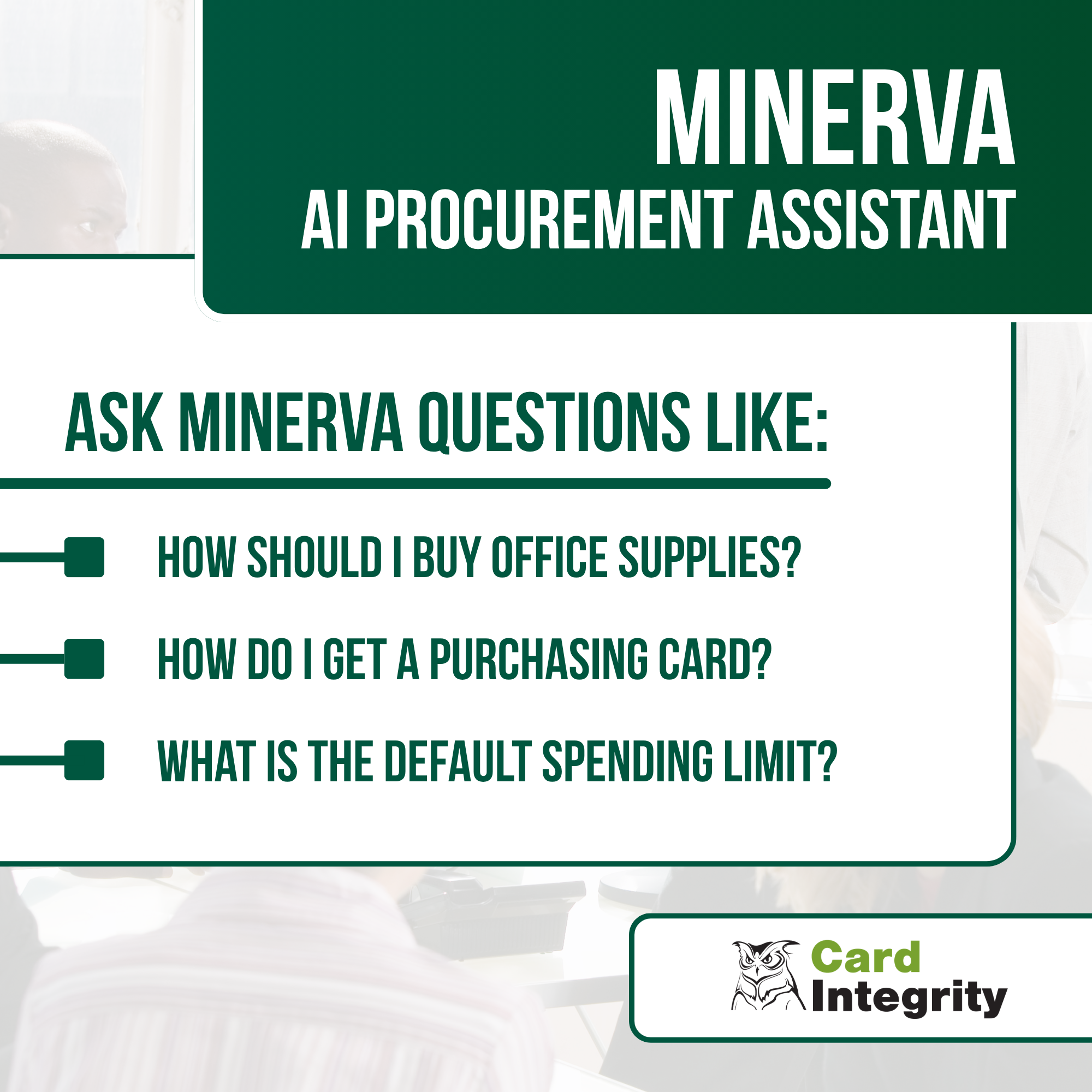
Check out our latest AI solution: Minerva
If you are looking for innovative ways to incorporate AI into your procurement processes, consider the menial work your team covers on a daily basis that if freed up, could make you more productive. For example, Card Integrity recently launched Minerva, an AI procurement policy assistant. Minerva was designed around the idea that procurement policies can often be cumbersome, both for cardholders/employees trying to get an answer to something, and for procurement professionals attempting to field their questions in a timely manner. Minerva is a bit of an out-of-the-box agentic AI in this way: it performs menial tasks, although it is not making changes to any data itself.